16 November 2026

Are we measuring social media success incorrectly?

Social media has changed dramatically over the last decade. 

Platforms have evolved, algorithms have shifted and new features are released almost constantly. Yet despite these changes, many businesses still measure success using metrics that were relevant years ago. 

While likes, comments and follower counts remain easy to track, they don’t always tell us the full story. 

Your audience might: 

❤️ Like your post because they enjoyed it 

📤 Share your post because they found it valuable 

📌 Save your post because they plan to use it later 

💬 Send it to a colleague because it helped solve a problem 

But only one of those actions is publicly visible to you. 

Some of the most valuable interactions now happen away from public view, making social impact harder to measure, but no less important. 


Does social media still matter? 

Absolutely. In fact, social media may have become more influential than ever before. 

While public engagement has changed, the role social media plays in the customer journey has evolved. It’s no longer just a place to build an audience or spark conversations. Increasingly, it’s where potential customers go to validate whether a business is credible, trustworthy and worth their time. 

Research shows that 82% of internet users worldwide use social media to research products they’re interested in buying, while nearly half visit a brand’s social profiles before purchasing from its website. 

An active social media presence acts as a form of social proof. When people discover a new business, they’re often looking for signs that it’s legitimate, knowledgeable and trusted by others. Regular activity, valuable content and genuine engagement can help build confidence long before a purchase or enquiry takes place. 


Likes aren’t everything 

From the original ‘thumbs-up’ to a range of reactions, likes have been part of social media for years. But while they can indicate that somebody enjoyed your content, they don’t necessarily demonstrate intent. 

  • A person who likes a post may scroll past and never think about it again. 
  • A person who saves a post plans to return to it. 
  • A person who shares a post believes it’s valuable enough to pass on to someone else. 

Those actions often provide a much stronger indication of relevance and impact. 


Shares are recommendations 

When someone shares your content, they’re putting their own reputation behind it. 

They’re effectively saying: “I found this useful, interesting or entertaining enough to show someone else.” 

And that level of endorsement is often significantly more valuable than a passive like. 


Saves signal value 

Not all content is consumed immediately. When users save content, they’re often indicating that they intend to revisit it. 

For brands creating educational, informative or inspirational content, saves can be one of the clearest indicators that you’re providing genuine value. 
 

Conversations are becoming more private  

There was a time when social media conversations happened almost exclusively in public. Comment sections were busy places, debates unfolded openly and engagement was visible to everyone. 

Today, much of that behaviour has moved into: 

  • Direct messages 
  • Group chats 
  • WhatsApp conversations 
  • Private communities 

Your content is still being discussed, it’s just that you’re not always part of the conversation (but don’t take it personally!). 

Perhaps the biggest shift is that social media is becoming less about public conversation and more about private recommendation. And recommendations, even when they’re invisible, remain one of the most powerful forms of marketing. They can influence purchases, drive branded searches and introduce your business to entirely new audiences, even when the evidence isn’t immediately visible within the platform itself. 


Social media’s role in discoverability is growing 

While shares, saves and conversations may not directly influence rankings in the same way as traditional SEO signals, they can increase visibility, strengthen brand awareness and help more people discover your business. 

The way people search is changing. Today, customers move between social media, search engines, AI-powered search experiences, websites and recommendations before making a decision. As a result, discoverability is no longer about being visible in one place. It’s about building a consistent presence across multiple touchpoints. 

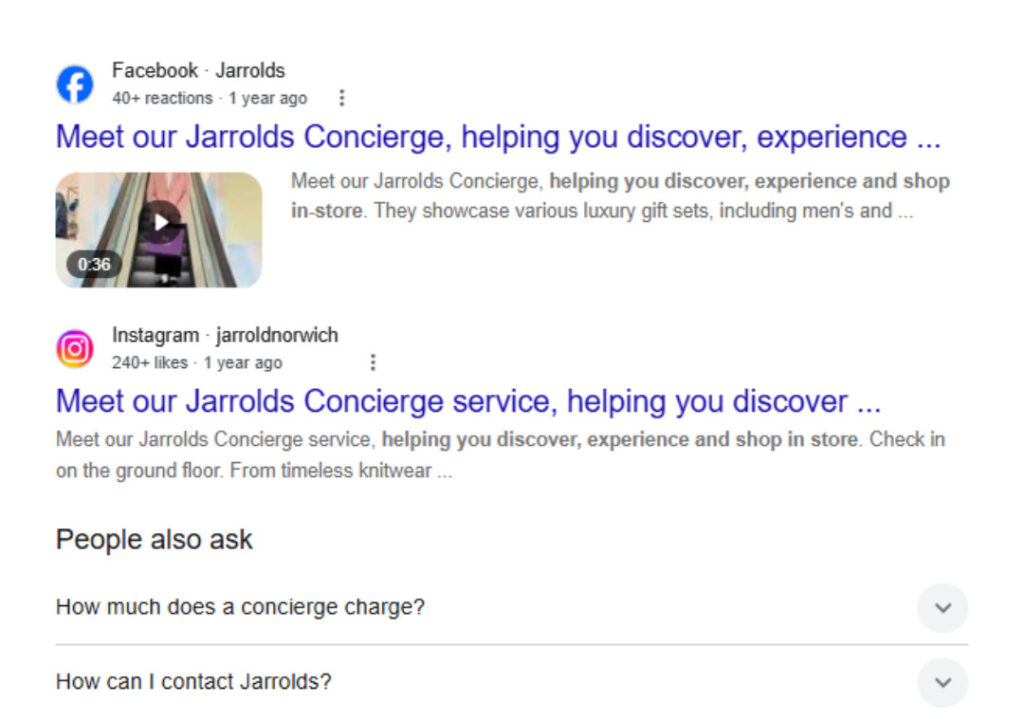
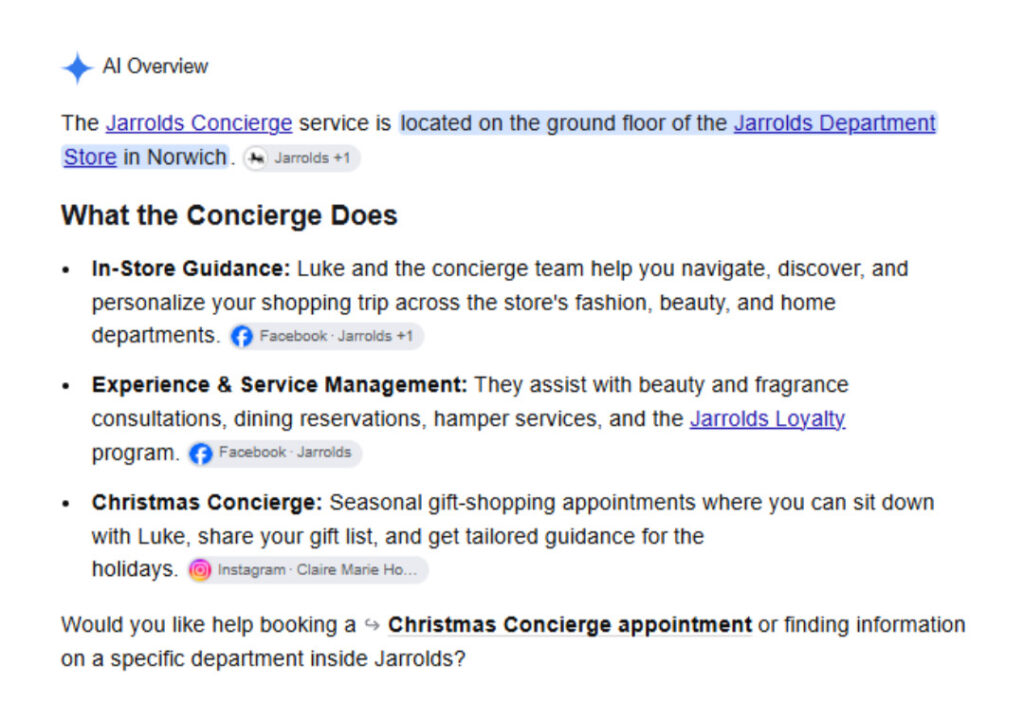
We’re beginning to see this reflected in search results. A search for the Jarrolds Concierge service, for example, returns not only the Jarrolds website, but also Facebook and Instagram content directly within the search results. Google’s AI Overview also references information sourced from these channels, demonstrating that social content is becoming part of the wider information ecosystem. 

screenshot showing Google ai overview referencing Jarrolds' facebook and instagram
Screenshot showing Jarrolds' facebook and instagram posts appearing in organic search results

This doesn’t mean every social post will appear in search results. However, it does highlight how discoverability is evolving. Social media is no longer operating entirely separately from search, and the content you publish can contribute to how your business is discovered, understood and validated across multiple platforms. 

Perhaps most importantly, it reinforces the role of social media as a credibility signal. An active, informative and consistent social presence doesn’t just support your audience on social channels. It can help strengthen your visibility and credibility wherever potential customers are. 


Not all engagement is created equal 

A post without likes isn’t automatically unsuccessful, in the same way that a post with 500 likes isn’t automatically delivering value. 

If we want to better analyse our content, we need to start asking ourselves whether our audience engaged in the way we were expecting. Did their engagement lead to a meaningful outcome? 

A save from a prospective customer may be more valuable than dozens of passive likes. A share into the right industry group may generate more business impact than hundreds of reactions. 

Understanding the context behind your engagement is often more important than the volume itself. Instead of measuring every post against the same engagement benchmark, consider what success looks like for that individual piece of content. 

A brand awareness post may be judged on reach and visibility. An educational post may be judged on saves and shares. A commercial post may be judged on website visits, enquiries or conversions. 

The metric should follow the objective, not the other way around. 


Measuring what matters 

Different objectives require different measurements, but social media reporting should focus on indicators of value and intent, not just visibility. 

Likes, follows and comments should still be monitored, but they shouldn’t be viewed as the sole indicators of success. Instead, they should be considered alongside the actions that demonstrate deeper engagement and stronger commercial intent. 

This might include: 

  • Shares 
  • Saves 
  • Profile visits 
  • Website clicks 
  • Direct enquiries 
  • Brand mentions 
  • Reach among target audiences 
  • Conversions and leads 


But perhaps the bigger shift is one of mindset 

Rather than creating content and then deciding whether it was successful based on the engagement it received, start by defining what success should look like before the content is published. 

An educational post may be designed to generate saves. A thought leadership piece may be intended to spark conversation. A commercial post may be focused on website visits or enquiries. 

When success is measured against the original objective, it becomes much easier to understand what’s working and why. 

After all, great content should support wider business objectives, not simply generate engagement for engagement’s sake. 


Conclusion 

Social media hasn’t become any less valuable, it’s just become harder to measure. 

Many of the signals that suggest content is working now happen privately, making traditional engagement metrics less reliable indicators of success.  

Likes still have a place, but they’re only one piece of a much larger picture. The most valuable interactions on social media often happen where you can’t see them. 

And that’s exactly why marketers need to look beyond vanity metrics and focus on the behaviours that genuinely drive awareness, trust and action. 

Social media is changing. The way we measure success should change with it. 

If you’re not sure whether you’re measuring the right things, we’d love to help. From social strategy and reporting to training and content planning, our team can help you get more from your social media activity.  

Let’s chat. 

No boring answers, no off-the-shelf thinking

Our take on digital marketing trends, updates, tips and tricks.

Up close of four people sat close together looking at phone screens

Are we measuring social media success incorrectly?

Chef using saltwrights salt

Supporting Saltwrights Through the Jarrold Growth Fund

Computer monitor showing the top section of the Yawn website home page

What is ‘The Fold’ and does it even matter? 

Up close image of a hand using a computer mouse

What Does Hotjar Actually Do?

Two people leaning over a laptop with a search engine on the screen

Does E-E-A-T still matter?

Aimée and Grace from the Yawn team working together at their desk in a modern, colourful office

What If Paid Media Testing Was Your Best Market Research Tool?

Woman looking at her phone in her hands

Good Email Marketing – The Basics

Fingers typing on laptop

Is SEO Important to Consider for Site Migrations?

lady using a bottle of skincare serum

Skincare Marketing is Never Skin Deep

Group of light bulbs with only one lit

How to Compete in a Competitive Space with SEO

Pie chart with majority blue and small section red

How to Market Niche Products or Services

Paid Digital Advertising: Setting up for Success 

Go to previous slide Go to next slide